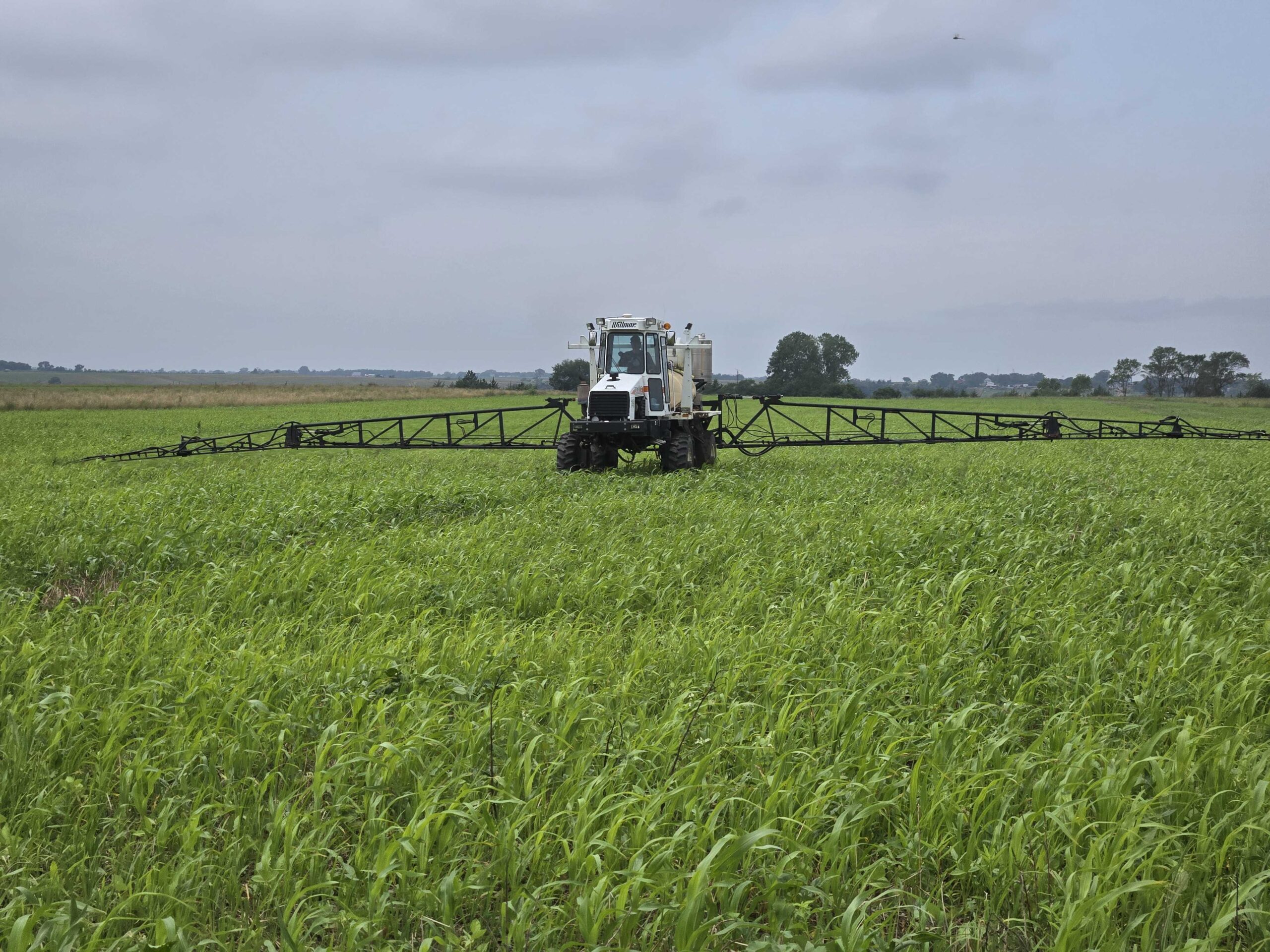
Every tank you mix starts with water. At 10 to 20 gallons per acre, it is likely the largest volume ingredient going through your sprayer, outweighing every herbicide, fertilizer and biological you add. We spend real time and money choosing products and rates, then assume the water is just along for the ride.
Water carries its own chemistry into the tank, and that chemistry reacts with everything you add. It keeps reacting after the spray hits the soil, too. Treating water as an ingredient rather than just a carrier is one of the simplest ways to get more out of the inputs you’re already paying for.
What’s really in your water
Much of the well water across Kansas and the Plains is hard and alkaline. In practical terms, that means a pH that often sits above 7.5, along with calcium and magnesium, the same minerals that leave white scale on equipment. Some wells carry sodium and other salts, as well. Those are the things most people picture when they think about hard water.
There are also bicarbonates in the water that act like a reserve that keep pushing pH back up. Add a little acid and the pH drops for a moment, but the bicarbonates neutralize it and the water drifts right back. That is why many growers find their water harder to adjust than they expected, and why a pH reading alone doesn’t tell the whole story.
What hard water does in the tank
Many herbicides, including glyphosate, 2,4-D and dicamba, work best in slightly acidic water, where more of the product stays in a form that moves easily through the waxy surface of a leaf. As pH climbs, more of it shifts into a form that has a harder time getting in. The product is still in the tank, but less of it is reaching the place it needs to work.
Hard water stacks other problems on top of that. Calcium and magnesium can bind to glyphosate and tie it up before it ever reaches a weed. High bicarbonate levels can reduce the performance of 2,4-D amine and some grass herbicides, and some insecticides break down faster in alkaline water, especially if a load sits before it goes out.
The water you mix with is the first thing every product in your tank has to contend with.
What happens after it hits the soil
The chemistry doesn’t stop when the sprayer shuts off. Bicarbonates in spray and irrigation water combine with calcium and magnesium in the soil to form carbonates that don’t dissolve easily. Phosphorus, iron, zinc and manganese can get pulled into those compounds as well, moving nutrients out of reach of the crop.
Over time, that process leaves more sodium behind in the soil solution, pushes pH higher, and can weaken soil structure. It is one reason irrigated ground with poor water quality can drift in the wrong direction even under a good fertility program. The water is quietly working against the program, one application at a time.
Your soil’s nutrient bank account
Most soils hold far more nutrients than a standard soil test shows as available. A total nutrient digest test often reveals large reserves of phosphorus, calcium and micronutrients sitting in forms plants can’t use yet. Decades of fertilizer and amendments have built that balance up, and in many fields it is far larger than what a crop needs in any one season.
The goal isn’t to drain that account. It’s to make small, steady withdrawals each year by creating conditions where roots and soil biology can reach what is already there. Plants do this on their own. Roots and the microbes around them release carbon dioxide, which combines with soil water to form carbonic acid, along with other acids that loosen nutrients from soil particles. Carbonic acid is the same weak acid that gives rainwater its natural pH of about 5.6, and it is one reason crops so often respond better to a good rain than to the same amount of well water.
That work isn’t free. A large share of the energy a crop captures through photosynthesis goes below ground to build roots and feed the biology that helps it find nutrients. Anything that makes the job harder, including water that keeps pushing pH and bicarbonates the wrong way, costs the plant energy it could have spent on growth.
Why weak acids work differently
Acids are a common tool for correcting hard water, but they don’t all behave the same way. Strong acids like sulfuric and phosphoric acid release all their acidity at once. They knock down pH and bicarbonates quickly, but the effect is short-lived, they can leave salts or excess sulfur behind, and they demand careful handling.
Weak acids release their acidity gradually. Instead of a single hit, they work steadily, more like water slowly wearing down a stone than a hammer breaking it. They also buffer, holding pH within a range rather than letting it swing. That steadier action is much closer to how carbonic acid behaves in a healthy soil, and it fits far better around living biology.
Growthful, which is a part of Elevate Ag’s HyprGrow products, is built on that weak-acid idea. It is designed to support the natural formation of carbonic acid in water rather than releasing all its acidity at once, giving a buffered, longer-lasting effect. For many of the same reasons, we also recommend adding Growthful as a water conditioner.
Where to start
The first step is simply knowing what you’re working with. Have each well you fill from tested for pH, bicarbonate or alkalinity, hardness, salts and sodium, since wells on the same farm can differ a lot. Before a full load, run a jar test with your own water and products in the right proportions, and make sure any water conditioner goes in first, ahead of the products it is meant to protect.
From there, look past the standard soil test. A total nutrient digest shows what is in your bank account, not just what is available today, and it often changes the conversation about what a field really needs. Small changes to the water going into your tank can unlock more of what you’re already paying for, both in the sprayer and in the soil.
If you’d rather listen, we dug into this topic on the Elevate Ag podcast with Mike Skinner, CEO of Aqueus. Click one of the links below to watch on YouTube or listen on Spotify!